The Tiger That Mauled Itself
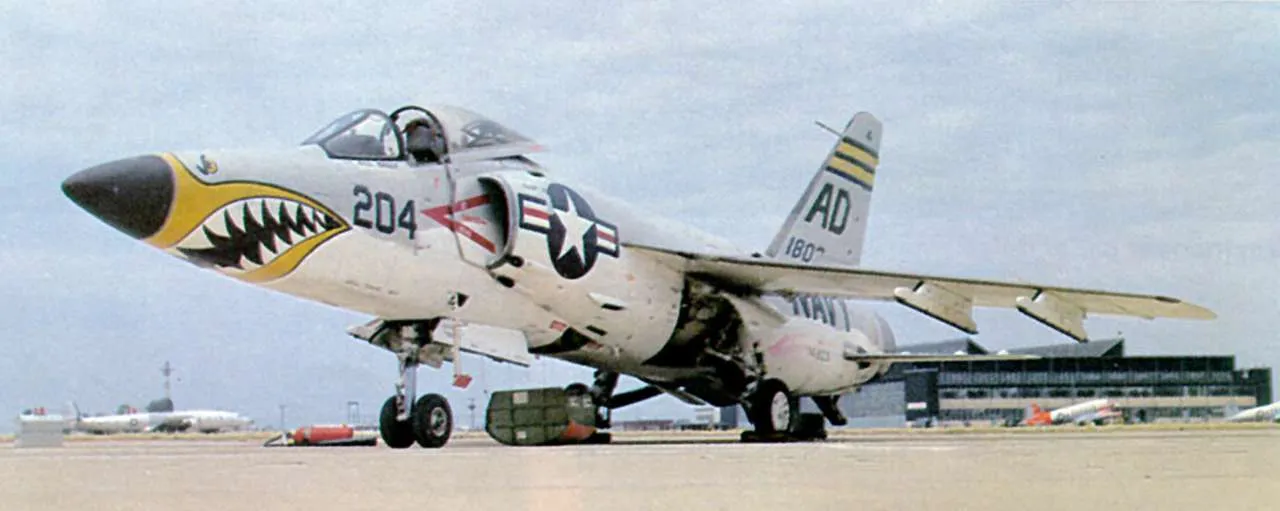
In aviation circles, the Grumman F-11 Tiger is known as a capable carrier-based fighter aircraft, the second operational jet in US Navy service that could fly faster than the speed of sound. In popular culture, it is better known as one of the first types flown by the Blue Angels and, most regrettably, it can also claim the title as the first fighter jet that managed to shoot itself down.
The accident occurred on this day, 68 years ago. Thomas W. Attridge, Jr, a young Grumman test pilot, was flying his second sortie of the day. He was tasked to take off from Grumman’s airbase on Long Island, proceed to the designated firing range over the Atlantic Ocean, and clear a test point on the performance flight envelope by strafing the water in two short bursts. Attridge was an experienced naval aviator who flew combat missions during WW2. The planned test sortie would have been a low risk operation for him. Except that it was not.
The F-11 Tiger evolved from the F9F Cougar with an advanced aerodynamic design, including a redesigned wing, only spoilers for roll control, full-span leading edge slats, folding wingtips, and a fuselage that followed the ‘Coke bottle area rule’ for reducing transonic drag. These airframe improvements, along with an afterburner-equipped engine, enabled the F-11 to achieve Mach 1.1 in a few operational scenarios. The design objective was to achieve the lowest possible airframe weight as the licence-built British engine did not have a robust thrust margin against the minimum design requirements. The aircraft had 4 20 mm Colt cannons installed aft of the engine air intakes with 125 rounds each.
During the early phase of gun firing tests, Grumman quickly discovered that the spent ammunition cases and links closely followed the airflow around the airframe, hitting and denting various wing and empennage areas. The spent links could cause significant damage to the horizontal stabiliser’s leading edge. As a temporary measure, a steel-reinforced (armored) leading edge was installed on flight test vehicles. Later, a complex modification was incorporated to the whole gun ejection subsystem, including an internal mechanism that retained the spent links and an extended ejection chute that ejected the spent cases further away into the airflow.
The flight test sortie tasked Attridge to conduct high speed firing tests of the cannons. The test card required him to start at 22,000 feet, accelerating past Mach 1.0 on afterburner in a 20 deg shallow dive, firing a short burst when passing through 13,000 feet, wait 3 seconds to cool the guns, then fire a second burst, ending the test point at 7,000 feet when he expended all his ammunition. Attridge followed the exact test profile, only to realise that his armored front windscreen was shattered by some foreign object. He immediately responded by reducing his speed to 200 KIAS, hoping to prevent further damage to his windscreen. Soon after, he identified a large gash on his right air intake and when he moved the throttle above 78%, the engine was running rough. He was flying the test sortie low over the Atlantic Ocean, not far from the shore. Not surprisingly, his initial conclusion was that he suffered a major birdstrike. Unfortunately, he could not reach the runway and crash landed less than a mile from Calverton airfield. He escaped from the burning wreckage, but sustained spinal injuries. Little known fact that the rescue helicopter sheared off the end tips of all main blades while hovering in the tree canopy above the injured pilot. Fortunately Attridge returned to flying duties in less than half a year after the accident.
The post-accident inspection confirmed that the F-11 was hit by at least three 20 mm rounds that were fired during the test. The first one hit the nose cone, the second destroyed the front windshield, and a third one entered through the air intake. Fragments were found in the engine fan and compressor sections. The engineers concluded thet Attridge shot himself down by flying into a stream of bullets that were on a downward trajectory, slowed down by aerodynamic drag. Subsequent investigations confirmed that the same test profile was flown during the first sortie of the day. A large dent found on the vertical stabiliser’s leading edge after that first sortie was originally written off as a typical damage caused by a spent link. As it turns out, the F-11 Tiger was hit by a 20 mm round that morning, Attridge narrowly escaping his first attempt at shooting himself down.
According to public comments made by the Deputy Chief of Naval Operations (Aviation), it was a “million-to-one” shot that led to the incident. In other words, the likelihood of repeating the event is extremely low. Attridge himself disagreed, highlighting that by flying high-performance fighter jets, the same scenario can easily be duplicated. I note that in 1973, less than 2 decades after the Tiger accident, an F-14 Tomcat shot itself down when testing a Sparrow missile off the coast of Point Mugu, California. Fortunately, both the pilot and the weapons system officer managed to eject the uncontrollable F-14 and survived the incident.
Risk controls that worked during the F-11 test flight incident are:
Hazards and risk controls that were missed:
Learning from experience is a critical element in system safety. In this blog post, I will revisit the impact of safety culture on what response can be expected from an organisation when a major accident happens. More specifically, I will explain the main reasons why a *pathological organisation* is not supportive of public inquiry and, as a result, unable to learn from a tragic safety loss.
3 min readNASA must address several challenges to safely fly and return humans to the Moon. The most time-sensitive issue is preparing Artemis II for a planned 10-day mission on a lunar orbit.
4 min readMy recent trip to the States involved connections in Auckland (NZ) and Houston (TX). On the way back home, I flew on a B737 MAX8 for the first time.
3 min read